RD Training Systems' Rick Kurtz success is built around the quality, expertise and passion of its team members, led by renowned speaker RICHARD KURTZ . Training Systems offers you the vision, motivation and tools to take your real estate business to the ultimate leve
The Federal Reserve is raising interest rates, and that's led some to worry that mortgage rates will spike and put an end to the housing boom in the United States.
Not so fast, according to the head of a big homebuilder.
Stuart Miller, executive chairman of Miami-based builder Lennar, said Tuesday that "concerns about rising interest rates and construction costs have been offset by low unemployment and increasing wages."
He added that there is still a "short supply" of houses on the marketafter"years of underproduction of new homes." And he said "demand remained strong" and "affordability remained consistent" thanks to rates that remain relatively low.
Miller made those remarks in Lennar's earnings release Tuesday morning. The company reported revenue and profits that topped Wall Street's forecasts.
Shares of Lennar (LEN) surged more than 7% on the news. Rival builders Pulte (PHM), DR Horton (DHI), Toll Brothers (TOL) and KB Home (KBH) all rose too.
Lennar's results are an encouraging sign for the group, which has been hit hard this year on fears that higher interest rates will start to takea bite out of demand for new homes.
Builder stocks have been hit hard this year, with many of them -- including Lennar -- falling more than 20% in 2018.
But Lennar's results and other recent data may be assuaging fears that the bottom is going to fall out of the housing market.
The federal government said Monday that new home sales in May were better than expected, citing particular strength in the southern part of the US.
That should be good news for the broader economy.
Lewis Alexander, chief US economist at Nomura, said in a report Tuesday that he was raising his GDP estimate for the second quarter, citing the stronger home sales figures and expectations of higher broker commissions.
And according to the closely watched S&P Case-Shiller index that was released Tuesday morning, home prices continued to rise across the country -- with 17 of the 20 cities tracked in the index registering increases.
"Given the combination of strong demand and lean inventories, especially for existing homes, we expect home prices to continue appreciating at a modest pace for the remainder of the year," said Barclays economist Pooja Sriram in a report Tuesday.
As long as the housing market remains stable, that should give consumers more confidence. To that end, the government reported strong retail sales figures for May earlier this month.
And it was led by healthy gains at home-improvement stores like Home Depot (HD) and Lowe's(LOW). These chains tend to do well when people are looking to sell their home.
The financial crisis was a decade ago, and many Americans have recovered. At the peak of the economic downturn, more than 30 percent of American homeowners owed lenders more than the value of their homes. Now, that number has finally dropped to under 10 percent.
However, millions are still reeling from aftershocks of the housing crisis: Nearly 4.5 million homeowners are underwater on their mortgages, according to a new report from Zillow.
In the late 2000s, the housing bubble burst sent home values into a freefall, with the typical U.S. home losing more than a quarter of its value when the market crashed, sending millions of homeowners into negative equity.
The situation is improving, but the outlook can appear bleak for Americans with underwater mortgages. Relief can be found with some options that exist for homeowners to avoid foreclosure:
Stay and pay: Don’t continue to throw money at a bad investment, but if the sense of obligation pulls you, you can continue to pay your mortgage bill month after month in the hope that your situation improves.
Consider a short sale: The goal is to get out of your home quickly and for the bank to forgive remaining debt. Homeowners should be prepared to sell their houses for a lower price than they paid for it.
Walk away: Only pull this strategic default card if you’re prepared for the consequences of a drop in credit score, a credit report blemish and guaranteed difficulty in securing a future loan.
Refinance your home: A lower interest rate and lower monthly payment through refinancing your mortgage might give you the relief you need in the short and long term.
Get a deed in lieu of foreclosure: This allows you to give the house to the lender and avoid foreclosure proceedings altogether. Chief among the benefits is that you are immediately released from most or all indebtedness associated with the defaulted loan and your credit suffers less.
Get a reverse mortgage: Available to individuals ages 62 and older, eligible homeowners can access a portion of their home equity by borrowing against it. Seniors can take the money in a lump sum, receive monthly payments, draw on it like a line of credit or use any combination of the three. The homeowner’s obligation to repay the loan is deferred until the homeowner dies or the home is sold.
Home loan modification: With a loan modification, lenders lower the interest rate and payment, either temporarily or permanently. It is also fairly common for lenders to extend the term of the loan or to allow borrowers to make up missed payments by tacking them on to the end of the loan or spreading them out over the remaining loan.
The best option to avoid foreclosure is to stay ahead of your bills, if possible. Research government mortgage assistance agencies like Home Affordable Refinance Program (HARP), Hardest Hit Fund (HHF) and Department of Housing and Urban Development (HUD) for free guidance on how to prevent a foreclosure.
Rick Kurtz and RD Training Systems are bringing their real estate training to Orlando, Florida this coming April 2018.
ORLANDO FLORIDA, -- Rick Kurtz and RD Training Systems are bringing their real estate training to Orlando, Florida this coming April 2018. This groundbreaking real estate training is to help professional agents stay up-to-date and on the top of many competitors. This training will give the participants a lot of good tools that can help them become a thriving result. There are a lot of things to be expected during the meeting, including high power and minute-to-minute content-rich presentations. Rick Kurtz, the speaker, focuses on proven systems which are made by Realtors for Realtors.
This seminar will teach real agents how to run a real estate business.
If you would like to know how to come to this or any of our other events, please don't hesitate to reach out and let us know.
As real estate agents, we are constantly inundated with offers of training to improve upon our existing business plans from marketing to the service we provide. With all that we have to choose from, it can be a wild west of uncovering what will be of the most value and deliver us the most up to date and effective strategies. All of this while also anticipating what is next going to be at the forefront of the real estate industry.
Tim and Tracey Kerin knew it was time to downsize soon after their grandson Maximus was born.
"We started to re-evaluate what's important to us at this stage in life and decided that our health and family were more important than a larger home with a big backyard and pool," says Tim, 58, who along with Tracey, 59, operate a commercial cleaning and construction business.
Last December, the Kerins packed up a two-story colonial replete with a beautifully landscaped garden in Damascus, Maryland, and moved to New Smyrna Beach, Florida, near their sons Justin, 35, and Jason, 33, and their families. And of course, they get to see Maximus, now 2. "We usually see Max a couple of times a week, and he spends one night every weekend, which we look forward to," Tim says.
The Kerins are not alone in their quest for a simple life centered on happiness. According to a recent TD Ameritrade Survey, 42 percent of preretirees are likely to downsize if they haven't done so already. Some 25 percent of respondents are moving to a warmer climate, and 17 percent are relocating closer to loved ones.
Another critical consideration is cost. "Retiring with a lower mortgage payment, property tax bill, smaller place to clean and maintain can be attractive," says Dennis LaVoy, CFP of Telos Financial in Plymouth, Michigan.
Run the numbers
Before downsizing, homeowners should run the numbers to make sure it makes financial sense.
"Look at costs associated with selling the primary home, such as preparing the house for sale, agent's commission, moving and buying a smaller home to get an idea of the fixed costs to relocate," says Aaron Galileo, senior loan officer at Investors Home Mortgage in Howell, New Jersey.
Once a person decides to downsize, he or she must keep lifestyle in mind. "You need to save as much as you can for retirement to keep your lifestyle intact," says Jeff White, a financial analyst at FitSmallBusiness.com. "If you can lower your monthly mortgage payment from $2,500 for the big home to $1,200 per month for a nice condo that fits you and your spouse, why not leap and invest the extra $1,300 into your retirement plan?"
Consider the space you need
The amount of space you have may also influence your decision to scale down. "If the kids have moved out and you're an empty-nester, do you need all of that space?" asks Brian Graves, co-founder of Everything But the House, an online estate sale marketplace. He says factor in how much space you need based on your family dynamic and the frequency of out-of-town guests.
For some homeowners, maintaining a property, especially an older one, is no longer attractive. That was the case for Sean Dougherty, age 51, and his wife, Juliana V. Atinaja-Dougherty, 56. In February, they moved into a two-bedroom, two-bath apartment in Manhattan after living for more than 20 years in the 2,000-square-foot single-family ranch house in Clifton, New Jersey, where his wife grew up. "The house was run down in small, but noticeable ways, and we kind of lost the emotional energy to fix it up for sale, so we priced it to sell," says Sean, a senior vice president at a public relations firm, and Juliana, an attorney. "Plus, we always wanted to move back to New York at some point, and having reached a point where we are more financially comfortable, it made sense."
Factor in cost-of-living changes
Part of their decision was doing the math and figuring out they could afford to do it, especially given that the move to New York would increase their cost-of-living expenses substantially thanks to the rent they now pay. The other part was wanting to enjoy the entertainment and cultural experiences of big-city living.
"In my case, I wanted to do more in New York like seeing friends, taking in a Broadway show or going to a book reading without worrying about the frustrating commute back to New Jersey," Sean says. Even still, they are happy with the move. "I put a ceiling on what we could afford, and I could still keep my job as my wife plans to retire soon," Sean says.
His best advice for those thinking about downsizing: "Don't wait too long. It's easy to live in the status quo of your life, but then you deny yourself other experiences."
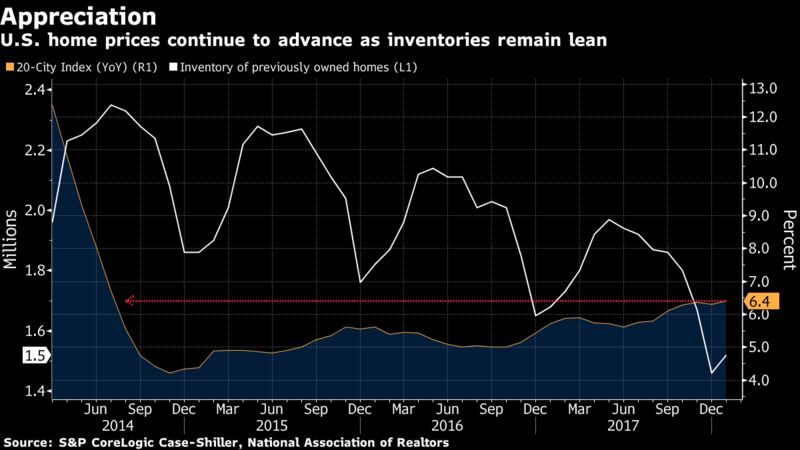
A limited number of properties for sale against a backdrop of steady demand helped keep home prices elevated in January, according to S&P CoreLogic Case-Shiller data released Tuesday.
HIGHLIGHTS OF HOME PRICES (JANUARY)
20-city home-price index increased 6.4% y/y (est. 6.2%), after rising 6.3% y/y
National gauge of home prices rose 6.2% y/y
Seasonally adjusted 20-city index advanced 0.8% m/m (est. 0.6%)
Key Takeaways
Home prices continue to post solid gains across the country, with the largest advances occurring in the West. While demand is being spurred by robust job growth, inventory remains lean and is allowing sellers to raise asking prices. The number of previously owned houses on the market during the month was the lowest for any January in National Association of Realtors’ records back to 1999.
Higher property prices and mortgage rates near a four-year high, however, are putting a dent in affordability. New-home sales have declined for three straight months, according to government data released Friday, while first-time buyers of previously owned houses made up a smaller share of total purchases in February.
Economist Views
“The home price surge continues,” David Blitzer, chairman of the S&P index committee, said in a statement. “Two factors supporting price increases are the low inventory of homes for sale and the low vacancy rate among owner-occupied housing.”
Other Details
All 20 cities in the index showed year-over-year gains, led by a 12.9 percent increase in Seattle and an 11.1 percent gain in Las Vegas
After seasonal adjustment, Seattle, San Francisco and Atlanta had the biggest month-over-month gains
Washington has the smallest month-over-month advance at 0.2 percent
WASHINGTON — U.S. sales of existing homes rebounded in February after declining for the previous two months, a sign that many Americans are still looking to buy despite rising prices and a shrinking number of homes available on the market.
The National Association of Realtors said Wednesday that sales rose 3% last month to a seasonally adjusted annual rate of 5.54 million. This increase after declining sales in January and December suggests that competition will be heated during the traditional spring home-buying season.
"The upward trend in home sales remains intact but there are headwinds in the way," said Jennifer Lee, a senior economist at BMO Capital Markets.
The shortage of properties for sale is creating a challenge for would-be homebuyers. As sales listings have steadily declined, prices have been climbing at the same time as a stronger job market has elevated demand — and, also, competition — for purchasing homes. Higher mortgage rates this year might also cause even fewer people to list their homes for sale, which would make the current supply squeeze worse.
The median home sales price was $241,700 in February, a 5.9% increase over the past year.
Prices are climbing, in part, because the number of sales listings has dropped. The supply of homes for sale declined 8.1% from a year ago to 1.59 million.
In February, sales climbed in the South and West but fell in the Northeast and Midwest.
First-time buyers appear to face the greatest obstacles from the decline in listings, according to an analysis by the real estate company Trulia. Starter homes have seen the steepest price increases as well as sharp drops in inventory — and a greater proportion of them are fixer-uppers that require additional investment from buyers.
Mortgage rates have been rising after President Donald Trump signed tax cuts into law toward the end of last year. The average 30-year mortgage rate was 4.44% last week, up from an average as low as 3.78% in early September, according to mortgage buyer Freddie Mac.
Real estate experts warn that higher rates could prompt more existing homeowners to keep their properties off the market, since selling their homes would require them to then buy a new home and pay more in mortgage interest.
After dipping by about 10 basis points in the middle of last week, mortgage rates recovered all of that drop and are now in line with where they stood a week ago, just shy of four-year highs. The average prime 30-year fixed mortgage rate quoted on Zillow stood at 4.29 percent on Wednesday.
Incoming economic news and Federal Reserve expectations have dominated market headlines in recent news cycles, but political/geopolitical developments once again seized markets' attention this week. Growing uncertainty about the direction of U.S. trade policy has pushed up the near-term risks to the American economy. Abroad, the results of elections in Italy raise risks to the European economic outlook.
To be clear, Fed news was still in the background: In testimony to the Senate Banking Committee on Thursday, Fed Chair Jerome Powell moderated comments made earlier in the week implying a faster pace of interest rate hikes than had been expected, but Fed Gov. Lael Brainard gave a speech echoing Powell's initial comments. In addition, reports of the likely candidates to fill the Fed's currently open Vice Chair role point to a more hawkish tilt to the Federal Open Market Committee.
The main economic news due this week is Friday's monthly jobs report. Absent a major disappointment, geopolitical news is likely to continue dominating the headlines.
The S&P CoreLogic Case-Shiller national home price index for November rose to 6.2% year over year to a non-seasonally adjusted (NSA) index of 195.94. The month-over-month percentage increase was 0.2%.
In all 20 U.S. cities included in the 20-city home price index, November house prices increased year over year, and 13 of 20 also posted NSA month-over-month increases. Seattle (12.7%), Las Vegas (10.6%) and San Francisco (9.1%) posted the largest year-over-year gains. San Francisco (1.4%) and Tampa (1.0%) posted the largest month-over-month increases, while Chicago and Cleveland posted 0.4% month-over-month declines, and Charlotte, Detroit and San Diego posted drops of 0.3% compared to October.
The S&P CoreLogic Case-Shiller NSA home price indexes for November increased by 6.4% year over year for the 20-city composite index and by 6.1% for the 10-city composite index.
Economists had estimated an NSA year-over-year gain in the 20-city index of 6.4%. The NSA monthly gain of 0.2% came in at the consensus estimate.
The index tracks prices on a three-month rolling average. November represents the three-month average of September, October and November prices.
Average home prices for November remain comparable to their levels in the winter of 2007.
The chairman of the S&P index committee, David M. Blitzer, said:
Home prices continue to rise three times faster than the rate of inflation. The S&P CoreLogic Case-Shiller National Index year-over-year increases have been 5% or more for 16 months; the 20-City index has climbed at this pace for 28 months. Given slow population and income growth since the financial crisis, demand is not the primary factor in rising home prices. Construction costs, as measured by National Income and Product Accounts, recovered after the financial crisis, increasing between 2% and 4% annually, but do not explain all of the home price gains. From 2010 to the latest month of data, the construction of single family homes slowed, with single family home starts averaging 632,000 annually. This is less than the annual rate during the 2007-2009 financial crisis of 698,000, which is far less than the long-term average of slightly more than one million annually from 1959 to 2000 and 1.5 million during the 2001-2006 boom years. Without more supply, home prices may continue to substantially outpace inflation.
Looking across the 20 cities covered here, those that enjoyed the fastest price increases before the 2007-2009 financial crisis are again among those cities experiencing the largest gains. San Diego, Los Angeles, Miami and Las Vegas, price leaders in the boom before the crisis, are again seeing strong price gains. They have been joined by three cities where prices were above average during the financial crisis and continue to rise rapidly – Dallas, Portland OR, and Seattle.
Compared to their peak in the summer of 2006, home prices on the 10-city and 20-city indexes remain down about 3.6% and 1.1%, respectively. Since the low of March 2012, home prices are up 49% and 52.3% on the 10-city and 20-city indexes, respectively. On the national index, home prices are now 6.1% above the July 2006 peak and 46.2% higher than their low-point in February 2012.
RD Training Systems just completed their very successful seminar in Salt Lake City, Utah Tuesday. It was an absolute pleasure getting to know the top agents in this market area and we want to see them exceed and move their business to the next level.
If you have any questions about this seminar or any future seminars, please contact us at
http://rdtrainingsystems.com or call our office and speak to one of our representatives to answer any questions you may have.
(844) 454-8787.
Rand, it was a pleasure to sit through your presentation. I've been a Realtor in Pocatello, Idaho for 40 years and started with Mike Ferry coming to little Pocatello, Idaho. First American Title had a contact with Mike and where I was from Costa Mesa and Mike's office was in Newport Beach, I really listened to everything he had to say. You took the Ferry selling thoughts of 1979 and put that selling technique on steroids...
Enjoyed all you had to say!
WIN THE DAY!
Gary Seymour
Recently RD Training Systems was in Virginia and our event was extremely successful. Here is a short clip from one of our presenters Rob about Stealth Marketing for Real Estate Agents.
For more information, please visit our website at
http://rdtrainingsystems.com
The short sale process can seem intimidating, yet getting a handle on the steps can make it a lot less scary—and help home sellers navigate a difficult financial situation without too much damage.
A short sale—where homeowners sell their property for less than they owe on their mortgage—is often the last resort for people who can't pay their mortgage and are facing foreclosure, explains Rachel Ivers, a junior agent at The Blake Team at Keller Williams in Aurora, CO.
So how does the short sale process work? Here are the steps involved, and what happens after the short sale is complete.
Before you assume you must have a short sale, talk to your lender or housing counselor about your situation. You may be able to get a loan modification and avoid having to sell your home, says Michele Lerner, author of "Homebuying: Tough Times, First Time, Any Time."
The federal Home Affordable Modification Program, a project run by the U.S. Department of Housing and Urban Development, may be an option. If you're eligible for HAMP, your mortgage company will likely put you on a three-month trial plan, giving you time to show you can make timely payments at a new monthly payment level. If you make it through the trial, you may have a new mortgage payment and avoid moving ahead with a short sale.
If loan modification is not an option, the next step is to move forward with a short sale.
2. Talk to your lender about a short sale
Since a short sale means you're trying to sell your house for less than you owe on your mortgage, your lender will have to sign off on it. But first, the lender is going to need proof that the short sale must happen, says real estate agent Lisa Blake, also of The Blake Team at Keller Williams.
"The sellers must submit a short sale packet, which includes hardship papers," Blake says. "Hardship papers show the bank that the seller is, in fact, undergoing financial hardship."
That paperwork may include bank statements and account information, income statements such as pay stubs, copies of bills and various expenses, asset disclosures, and more.
3. Contact a real estate agent
Of course, you'll need a real estate agent to sell your property—and since short sales are complex, you'll want an agent with experience in the short sale process to handle the deal.
You can search for agents in your area with certain expertise on realtor.com®'s Find a Realtor tool. Keep an eye out for someone who has become a Certified Distressed Property Expert, which means the pro has completed coursework related to short sales and foreclosures.
Once you reach out, the agent will then review your financial situation, as well as the home's estimated value, to come up with a listing price.
4. List your property
This is one step in the short sale process that is like any other property sale—the home in question is listed by your real estate agent, who will try to find a buyer and get the home under contract.
Once you have an offer from a buyer, this will need to be submitted to your lender for review. Further negotiations may be required between your agent, the buyer's agent, and the lender until a settlement is reached.
If your lender has opted to approve your short sale under the U.S. Treasury’s Home Affordable Foreclosure Alternatives program, this will all be done in about four months. If you didn't qualify for HAFA, the process can take longer.
5. Close the deal
If your lender approves your buyer, all is good. You move out. The buyer moves in. The funds used to purchase the house will go to your lender, and your mortgage debt will be forgiven. If you qualified for HAFA, you will also walk away with $3,000 in moving expenses. If you didn't, you simply walk away without that mortgage debt on your shoulders.
After a short sale, how long before I can buy a new home?
Granted, there are repercussions to selling your home in a short sale. The IRS will treat your forgiven mortgage debt as taxable income, so you may still end up owing money to Uncle Sam in the form of income tax. And your credit score could take a hit, since you're not paying the full debt you agreed to pay when you took out the mortgage.
Yet short sales have a few advantages, too. Not only will they get a seller out from under the threat of foreclosure and out of debt, but they also allow you to stay in your home during the selling process, says Sarah Naylor, an agent with the Patty Turner Group in Rockwall, TX.
Typically you can apply for a conventional loan within four years of a short sale. This may seem long, but it's far better than foreclosure, where lenders tend to expect you to wait seven years.
"A short sale does look better in the bank's eyes than a foreclosure," Naylor adds. "The bank appreciates that you came to them with your inability to pay as opposed to just leaving your home."
RD Training Systems & Rick Kurtz Are Coming to Salt Lake City, Utah This December
Rick Kurtz and RD Training Systems are bringing their real estate training to Salt Lake City, Utah this coming December 2017.
Rick Kurtz and RD Training Systems are bringing their real estate training to Salt Lake City, Utah this coming December 2017. This ground breaking real estate training is to help professional agents stay up-to-date and on the top of many competitors. This training will give the participants a lot of good tools that can help them become thriving result. There are a lot of things to be expected during the meeting, including high power and minute-to-minute content rich presentations. Rick Kurtz, the speaker, focuses on proven systems which are made by Realtors for Realtors.
This seminar will teach real agents how to run a real estate business.
If you would like to know how to come to this or any of our other events, please don't hesitate to reach out and let us know.
Call Us Today at (844) 454-8787
or visit our website at http://rdtrainingsystems.com
As real estate agents we are constantly inundated with offers of training to improve upon our existing business plans from marketing to the service we provide. With all that we have to choose from it can be a wild west of uncovering what will be of the most value and deliver us the most up to date and effective strategies. All of this while also anticipating what is on the fore front of the real estate industry.
Today's successful agents need to be armed with the latest strategies and ideas to stay ahead of the competition. We offer powerful strategies to take real estate agents to the next level. Designed by agents, for agents, our systems can be implemented immediately to drastically increase income, guaranteed.
RD Training Systems has been helping real estate agents and companies invigorate their business strategies, generate qualified buyers, and increase their sales flow. The system is designed by top active agents using proven techniques and tools guaranteed to drive your business to the ultimate level – Our program really works!
Today's successful agents need to be armed with the latest strategies and ideas to stay ahead of the competition. We offer powerful strategies to take real estate agents to the next level. Designed by agents, for agents, our systems can be implemented immediately to drastically increase income, guaranteed.